
How to Memorize Chinese Characters Using Radicals
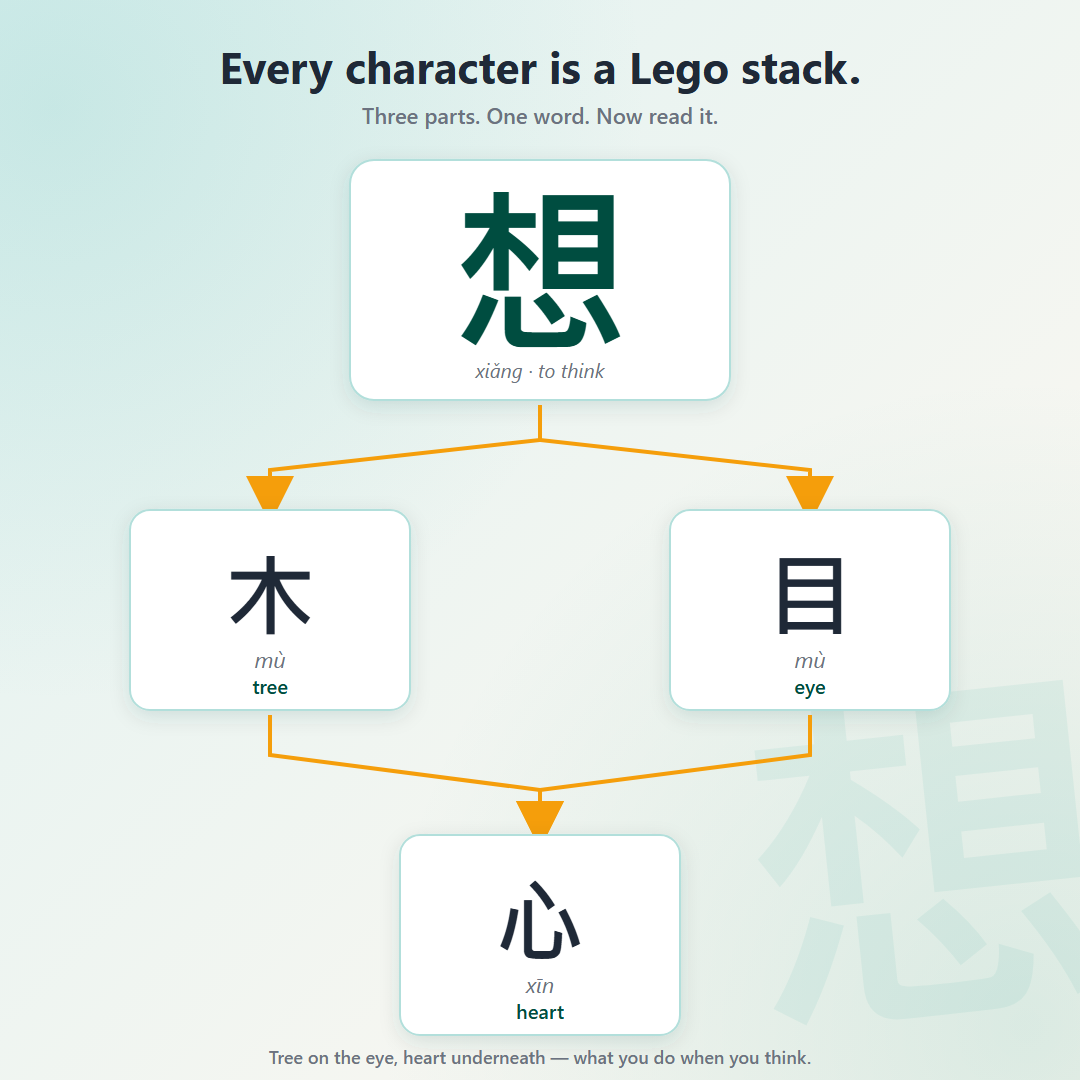
You stare at 想 and see fifteen meaningless strokes. The fluent reader sees a tree, an eye, and a heart, stacked like Lego: 木 sits on top of 目, and the whole top half perches on 心. The character means "to think," and once you can see those three pieces, the meaning is almost embarrassing in its obviousness. Your mind climbs the tree, looks out from the eye, and the feeling settles in the heart. That is not a mnemonic. That is the etymology, more or less intact across three thousand years, sitting in plain view on the page.The gap between your experience and the fluent reader's is not talent, and it is not the thousand hours you have not yet put in. It is that you are still trying to memorize the whole character, and they stopped doing that around character two hundred.
Why rote copying fails before you finish the page
Walk into any beginner Mandarin classroom and you will find learners doing the same thing they did with French verb conjugations: copy the character ten times in a grid, mouth the pinyin, move on. It is the default tool, and it is exactly the wrong one. Cognitive science has been clear about this for two decades. Roediger and Karpicke's 2006 paper on test-enhanced learning showed that repeated rereading produces strong recall when you measure five minutes later, but at two days and one week the curve collapses; active retrieval, the kind of effortful pulling-from-memory that feels like work, is what produces durable retention. Copying a character thirty times is, neurologically speaking, rereading with a pen.
There is a second, deeper problem. Tulving and Thomson's encoding specificity principle, from 1973, says roughly this: the operations you perform during encoding determine what cues will retrieve the memory later. If you encode 想 as "fifteen wiggly lines I copied on lined paper," then "fifteen wiggly lines" is your only retrieval cue, and you cannot generate it on demand in a reading sentence. If you encode it as 木 + 目 + 心, you have three cues, each of which connects to dozens of other characters you already know, and the whole network lights up when you see it again in 思想 or 理想.
Characters look chaotic only until you learn the parts list — and learning that list is both the entire problem and the entire fix.
How do you memorize Chinese characters using radicals?
Stop trying to memorize the whole character at once. Break it into its radical components — the recurring visual units that carry meaning across hundreds of characters. The top fifteen radicals appear in a substantial share of the characters you will meet in HSK 1 through HSK 4, and learning them with etymology turns reading from memorization into parsing. The Merry Mandarin component breakdown system shows the etymology and component map for each.
That top fifteen, for orientation: water 氵, person 亻, mouth 口, tree 木, heart 心, hand 扌, speech 讠, moon 月, silk 纟, grass 艹, fire 火, earth 土, woman 女, sun 日, metal 钅. The rest of this post is the long version of the short answer above. If you want the practical version of how to memorize Chinese characters using radicals in a way that actually sticks, you need three things: the right fifteen to start with, a workflow for decomposing characters you have not seen before, and a way to keep the components from quietly fading between study sessions. The Merry Mandarin component breakdown system handles the first; the Hanzi decomposition workflow at the end of this post handles the second; and a properly tuned spaced-repetition schedule handles the third.
The radical system, briefly, so the rest makes sense
A radical, in the strict sense, is one of the 214 components established by the Kangxi Dictionary, published in 1716 under the Kangxi Emperor. The Kangxi system was an indexing scheme — a way to look up characters in a paper dictionary before alphabetic input existed — and it has been the standard ever since. In practice, "radical" has come to mean something looser: any of the recurring component pieces, semantic or phonetic, that build up complex characters. That looser sense is the one you want, because it is also how more than ninety percent of modern characters were actually constructed.
Over ninety percent of modern Chinese characters originated as phono-semantic compounds — one component hinting at meaning, another at sound. The frequently cited figure in pedagogy is about eighty percent for the common set, which is the number Olle Linge at Hacking Chinese uses to make the case for learning phonetic series . Either way, this is the structural fact that radical study leans on. Characters are not pictures of things, except for a small ancient core. They are spellings, in a system where the alphabet is roughly 250 components and each component carries a hint about either meaning or sound.
A small complication, which matters for any Chinese character radicals chart you find online: the mid-twentieth-century PRC simplification rollout collapsed several radical forms into shorthand variants. The State Council promulgated the Chinese Character Simplification Scheme on 31 January 1956, and successive lists through 1964 standardized variants like 糸 → 纟 for the silk radical when used on the left. If you study 繁体 and 简体 in parallel, you will see both forms in the wild. Pick one as your home script — this article uses Simplified — and learn the other set as variants once the system is in your head.
The five star radicals: 氵, 亻, 口, 心, 纟
Begin with these five. Together they sit inside an astonishing share of everything you will read in your first two years.
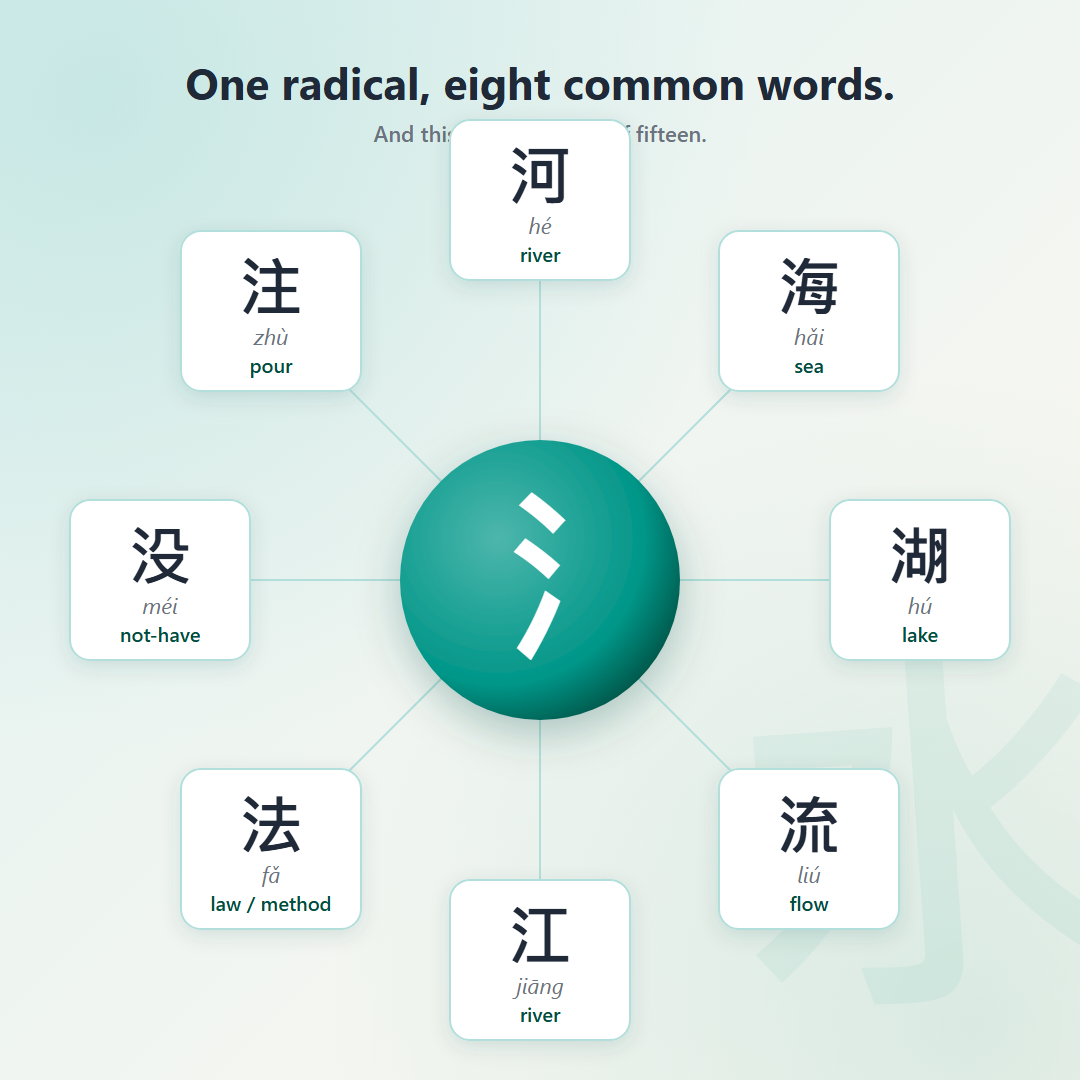
氵 — water (three drops on the left). The full form is 水, which you also see standing alone. Anything liquid, anything that flows, anything to do with rivers or rain or washing tends to wear this. 河 river, 海 sea, 汁 juice, 没 not-have (originally "submerged"), 洗 to wash, 酒 alcohol. Once you spot it on the left edge of a character, you have already cut your search space by a factor of fifty.
亻 — person (the standing-person radical). The full form is 人. On the left side of a character it compresses to two strokes. Anything human, anything social, anything about doing or being. 你 you, 他 he, 们 plural marker, 住 to live, 做 to do, 像 to resemble. The 亻 family is enormous and almost always semantically transparent.
口 — mouth. A square, drawn in three strokes. It appears as itself in 口 mouth and 嘴 mouth, but more interestingly it lurks inside dozens of speech and sound characters: 吃 eat, 喝 drink, 叫 call, 听 listen, 唱 sing, 哭 cry, 笑 smile (the bamboo on top is for the upturned-mouth squint). When you see 口 you should expect the character to do something a mouth does.
心 — heart, or its compressed form 忄 on the left. Anything emotional or cognitive. 想 to think, 思 to think more reflectively, 怕 to fear, 忙 busy, 怎 how, 念 to miss, 情 feeling, 爱 love (the simplified form, which controversially removed the heart from the middle and which generations of teachers have complained about ever since). The 心 family is where Chinese psychology, in the lexical sense, lives.
纟 — silk (the simplified left form, from 糸). Anything woven, tied, bound, related to thread or cloth or by extension to systems and structures. 红 red (cloth-dyed), 经 to pass through (warp threads), 纸 paper, 给 to give, 绿 green, 线 line. The 纟 radical reaches into surprising places once you start looking; abstract nouns about connection and continuation often run through it.
Five radicals, and you have a handle on hundreds of characters in HSK 1 through HSK 3. Notice that none of these are mnemonics in the Heisig sense — no stories about a person standing next to a tree. These are real etymologies, give or take a few millennia of drift. The fluent reader is not making up stories. They are reading the spelling.
Merry Mandarin · Radical Wheel
Tap any radical to see eight characters it builds.
The other ten that round out your Chinese character radicals chart
The remaining ten of the top fifteen are equally load-bearing.
木 — tree. 林 forest, 森 deeper forest, 树 tree, 桌 table, 椅 chair, 校 school (originally a wooden enclosure), 楼 building, 桥 bridge, 根 root. Anything once made of wood.
扌 — hand (left-side form of 手). Verbs of physical action almost universally carry this. 打 hit, 拿 take, 找 look for, 把 grasp, 接 connect, 挂 hang, 推 push, 拉 pull. If a verb involves your hands, expect 扌.
讠 — speech (simplified left form of 言). Anything spoken, written, promised, argued. 说 say, 话 speech, 语 language, 请 please/invite, 谢 thank, 问 ask, 让 let, 认识 to know. Again, the simplification dropped a few strokes but the semantic load is intact.
月 — moon, and also flesh. This one rewards a footnote. Two etymologically distinct components — 月 moon and 肉 flesh — converged in form and are now visually identical in most fonts. When 月 sits inside characters about the night sky or time — 明 bright, 期 period, 朝 morning — it is genuinely the moon. When it sits inside body-part characters — 肝 liver, 肠 intestine, 胃 stomach, 脚 foot, 肺 lung, 脑 brain — it is the flesh radical wearing a moon's coat. Knowing which is which will not change your reading much, but it will stop the etymology from feeling like a riddle.
艹 — grass (the two little cross-strokes on top). Plants and herbs. 花 flower, 茶 tea, 菜 vegetable, 草 grass, 苦 bitter (literally a bitter herb), 药 medicine, 萄 grape, 菇 mushroom. If it grows from the ground and is not a tree, it probably wears the grass hat.
火 — fire, sometimes flattened to four dots 灬 underneath. 灯 lamp, 烧 burn, 热 hot (the four dots are fire from below), 然 thus (originally "to burn"), 煮 to boil, 焦 scorched. The four-dot form catches beginners off guard until somebody points it out, after which it never does again.
土 — earth. 地 ground, 场 field, 城 city wall, 坐 to sit (two people on the earth), 块 a piece, 在 to be at. Anywhere physical, anywhere built from soil or stone.
女 — woman. 妈 mom, 姐 older sister, 妹 younger sister, 好 good (woman + child), 她 she, 婚 to marry, 安 peace (a woman under a roof). A radical with a complicated cultural history that is worth a separate post.
日 — sun. 早 early, 时 time, 明 bright (sun + moon), 晚 late, 春 spring, 星 star, 是 to be (originally something like "right under the sun"). Time and brightness almost always involve 日.
钅 — metal (simplified left form of 金). 银 silver, 钱 money, 铁 iron, 钟 clock/bell, 锅 wok, 错 wrong (originally a kind of file or grinding tool). Anything metallic, plus a surprising cluster of abstract characters whose ancient referents were metal objects.
That is your Chinese character radicals chart in fifteen pieces. Print it, screenshot it, tape it next to your monitor. The interactive version at the top of this page will let you tap each one to see its etymology and a sampling of the high-frequency characters it appears in.
Stop trying to memorize the whole character. Learn its parts, and the rest assembles itself.
When the radical lies: false friends and simplification splits
A frank warning before you go too deep. Radicals are guides, not guarantees. There are three traps.
The first is the 月 problem above: visual identity hiding etymological difference. You will see "moon" inside 肝, and the meaning will not click until you know about the flesh-radical merger.
The second is simplification splits. The mid-1950s rollout of simplified components collapsed some distinctions that traditional script still preserves. 发 in Simplified covers both 發 "to issue" and 髮 "hair" in Traditional. The radical you can see in the Simplified form is not always the radical that produced the meaning historically. If a character feels semantically incoherent under decomposition, check the traditional form before blaming your study method.
The third is phonetic components masquerading as semantic ones. Over ninety percent of characters are phono-semantic compounds, which means one of the components is there for sound, not meaning. 妈 mā has 女 for the "woman" sense and 马 mǎ purely for the sound. If you try to extract meaning from 马 in 妈, you will write yourself a mnemonic about a woman riding a horse, which is fun and unhelpful. Learn to recognize phonetic series — 青 in 请 qǐng, 清 qīng, 情 qíng, 晴 qíng — and you stop being surprised by them.
None of this undermines the method. It just means that radical study, like any analytical tool, has edges, and a good reference will tell you which side of the edge you are on.
A four-step Hanzi decomposition workflow that actually sticks
The workflow below is the practical answer to the question. It is also the pipeline that the Merry Mandarin component breakdown system, the Merry Mandarin Dictionary, and the Merry Mandarin FSRS-5 review engine were built to support, in the order you should use it.
Step 1: Learn the top 15 radicals — covers 500+ high-frequency characters
Spend a week, maybe two, on the fifteen above. Not in isolation: learn each one alongside five or six characters that contain it, so the radical lands as a pattern rather than a flashcard. By the end you should be able to look at any HSK 1 or HSK 2 character and identify at least one familiar component inside it. That is the floor. The Merry Mandarin component breakdown system gives you the full radical set with etymology, but starting with the top fifteen is where the leverage is highest.
Step 2: Decompose new characters into their radical components
When you meet a new character, before you do anything else, look at it and name the parts. 谢 — speech radical on the left, body radical 身 in the middle, inch 寸 on the right. 想 — tree, eye, heart. 河 — water, can 可. This is what Hanzi decomposition means in practice, and it should become as automatic as syllabifying English words. The point is not to guess the meaning, though sometimes you will. The point is to encode the character as three pieces instead of as a single visual blob, so that retrieval has handles to grab.
Roediger and Karpicke's testing-effect work and Tulving and Thomson's encoding specificity together imply something useful here: the act of decomposing is itself a retrieval event, and the cues you create — these three named radicals — are exactly the cues you will be able to regenerate when you see the character in a sentence next week.
Step 3: Use the Merry Mandarin Dictionary to confirm meaning
Decomposition gives you a hypothesis. The Merry Mandarin Dictionary, with its 14,000 entries and human-written example sentences, gives you the confirmation. Every entry shows classifiers, usage notes, common confusions, and contextual examples drawn from real Mandarin — not the sterile sentence fragments you find in most reference apps. This is where you find out that your "tree-eye-heart" decomposition of 想 is in fact the etymology, and that 思 (rice paddy plus heart, formerly skull plus heart) is the more reflective synonym you should reach for when describing deep thought.
The Merry Mandarin Dictionary also flags the false-friend cases discussed above. When a phonetic component is doing the work, the entry says so. When a traditional/simplified split has muddied the etymology, the entry shows both forms.
Step 4: Schedule retention with the Merry Mandarin FSRS-5 review engine
Decomposition does the encoding. Retention requires spacing. The Merry Mandarin FSRS-5 review engine schedules each character — and each radical — for review at the moment your forgetting curve says you are about to lose it, which is up to 20% fewer reviews than older SM-2-based schedulers for the same retention. The scheduler treats components and full characters as related items, so reviewing 河 reinforces 氵 and 可, and a slip on 请 surfaces the 讠 cluster for a quick refresh.
That is the loop. Learn the top fifteen, decompose every new character into its parts, confirm with the Merry Mandarin Dictionary, schedule with the Merry Mandarin FSRS-5 review engine. Each step is small. The accumulation, over a few months, is the difference between staring at 想 and seeing the tree.
Where this leaves you
If you are at HSK 1 or HSK 2 and you have been copy-copy-copying your way through new vocabulary, the shift to radical-based study will feel slow for about a week and then it will feel like a different language. If you are at HSK 3 or HSK 4 and you have hit the rote-memorization wall — somewhere around the eight-hundredth character, where new ones stop sticking and old ones start blurring together — this is the lever you were missing. The wall is not a sign that you have hit a ceiling. It is a sign that the method has run out of room.
The Merry Mandarin component breakdown system covers many radicals with etymology and shows the decomposition for every character in the HSK 1–6 course ladder, with the Merry Mandarin Dictionary one tap away for confirmation and the Merry Mandarin FSRS-5 review engine handling the spacing. It works offline, the pronunciation grading runs on-device, and the interactive cheatsheet above lives on this page for as long as you need it. Merry Mandarin is built for exactly this work.