
Mandarin Fluency Calculator: How Long Does It Take to Learn Chinese?
Every Mandarin learner Googles the same question in their first month, and then again in their third year. The first time, they want hope. The second time, they want a map. The promises that come back are mostly lies dressed in motivational language — "fluent in six months," "conversational by summer," "speak Chinese like a native in 90 days." None of these survive first contact. A fluent reader recognizes most characters in about forty milliseconds and a beginner stares at them for forty seconds before forgetting again by Tuesday.
So here is the honest answer, the one nobody quotes because it sounds too long: roughly 2,200 hours of focused work to reach professional working proficiency. That number is not a marketing estimate. It comes from sixty years of U.S. State Department language training, and it is the most reliable figure anyone has ever published about how long it takes to learn Mandarin.
The good news is that 2,200 is the destination, not the route. The route bends. Some hours are slower than others. Some can be cut with the right structural choices. The first half of this article explains where the number comes from and why it survives every attempt to debunk it. The second half breaks the climb into four honest tiers, shows you how to locate yourself on the ladder, and names the specific accelerators that turn rote hours into productive ones.
How long does it take to learn Mandarin?
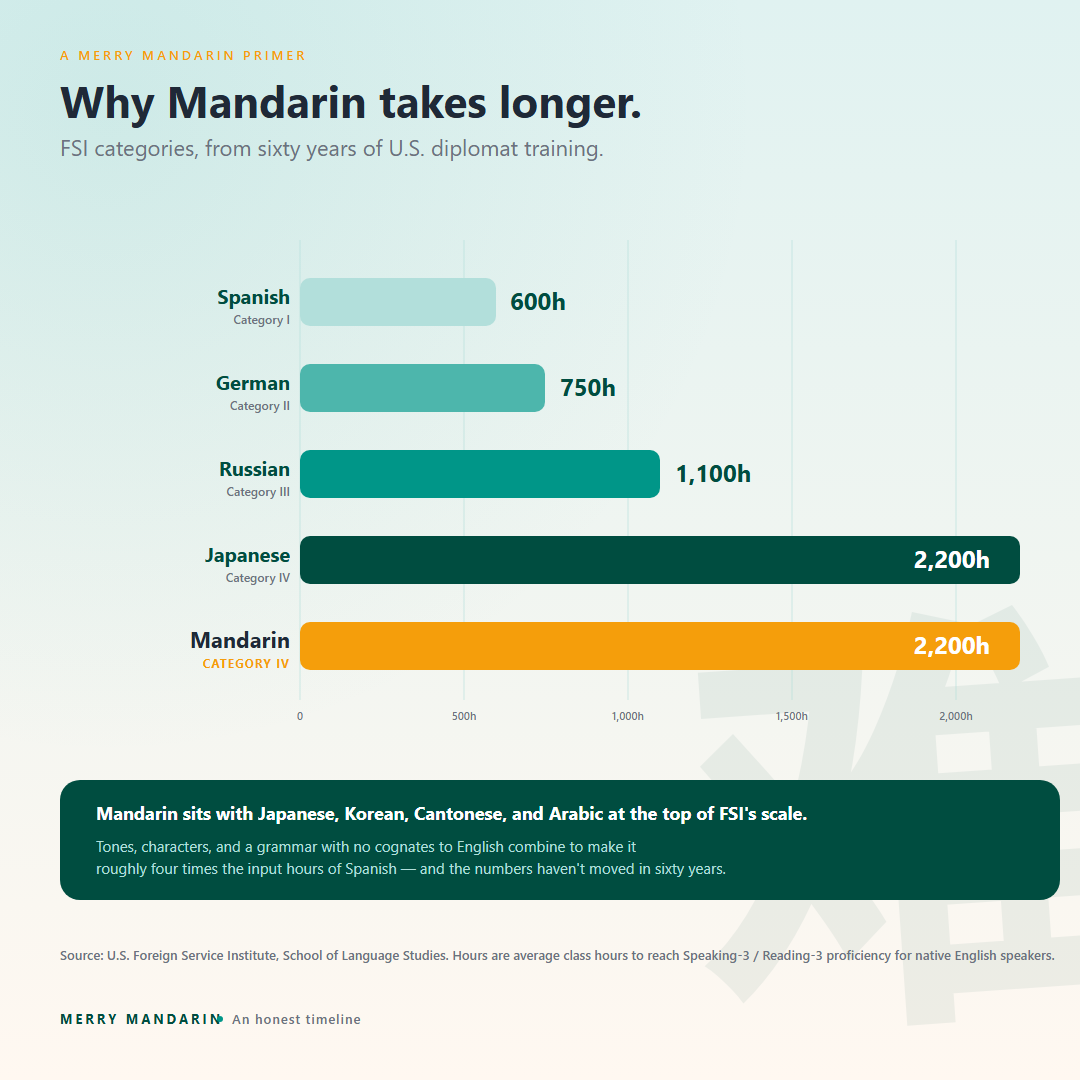
The U.S. Foreign Service Institute classifies Mandarin as a Category IV "super-hard" language and estimates 2,200 class hours to reach professional working proficiency, roughly four times what Spanish takes. The path breaks into four honest tiers: travel survival around 150 hours at HSK 1-2, daily conversation around 600 hours at HSK 3-4, professional fluency around 2,200 hours at HSK 6, and mastery of classical and academic registers at 4,000 hours and beyond, in the HSK 7-9 range.
That is the snippet answer. The rest of this article is the asterisks, the accelerators, and the map.
Why FSI's 2,200 hours is still the most honest number
The Foreign Service Institute was formally established on March 13, 1947, under the Foreign Service Act of 1946, and its School of Language Studies has been training American diplomats in foreign languages ever since, as the American Foreign Service Association has documented in its institutional history. In its first year, the school taught thirty-one languages to five hundred and fifty-nine students and delivered more than thirty-four thousand hours of instruction. Decades of that data — students moving through classrooms five hours a day, five days a week, under standardized testing — gave FSI something almost no commercial language company has: a longitudinal record of how long humans actually take to reach a defined proficiency level on the Interagency Language Roundtable scale.
The scale they use stops at S-3/R-3, which the ILR defines as "professional working proficiency": you can hold meetings, draft memos, follow news radio, conduct interviews. It is not native, and it is not the cocktail-party charm sometimes labeled "fluent" in app marketing. It is the level at which an American diplomat can do the job in the language.
or Romance languages — Spanish, French, Italian — FSI puts the figure at twenty-three to twenty-four weeks of intensive study, or roughly 575 to 600 hours, according to the Atlas & Boots breakdown of FSI's published rankings. German sits at thirty weeks, around 750 hours. Russian, with its case system and Cyrillic, climbs to forty-four weeks at about 1,100 hours. Then comes the cliff. Mandarin Chinese, Cantonese, Japanese, Korean, and Arabic share the top category at eighty-eight weeks and 2,200 hours, a tier FSI itself describes as a "small group of super-hard languages." Mandarin takes nearly four times what Spanish takes, and the gap is not a rounding error.
The reason it survives debunking is that nobody has produced a better dataset. Polyglot YouTubers with three-month challenges produce anecdote; FSI produces N. When critics point out that diplomats are unusually motivated and unusually well-resourced, they are correct, which means the 2,200-hour figure is probably a floor, not a ceiling, for the average self-taught learner. The figure also counts classroom instruction only; as GoEast Mandarin has documented, FSI students put in roughly twenty-five hours of class and fifteen to seventeen hours of homework weekly, so the realistic total when self-study is included can be six hundred to sixteen hundred hours higher.
This is what people mean, even when they don't realize it, when they ask how long does it take to learn Mandarin. They want a number that survives scrutiny. The FSI Mandarin hours figure does.
The four-tier ladder: Survival, Conversational, Professional, Mastery
The 2,200-hour figure is paralyzing in the abstract and useful only when you break it into tiers a human being can aim at. Here is the honest ladder.
Tier 1: Survival, ~150 hours, HSK 1-2
This is the tier where you can order 牛肉面 (niúròumiàn, beef noodles), ask where the MRT is, count money, and read enough signage to find the bathroom. The GF0025-2021 cumulative table puts HSK 1 at roughly 500 words and 300 characters, with HSK 2 building from there. At an hour a day, you reach the top of this tier in about five months. Most learners overshoot it, get a small dopamine hit from a successful taxi ride in Taipei, and then quit before the next tier — which is the tier that matters.
Tier 2: Conversational, ~600 hours, HSK 3-4
At HSK 4 the official vocabulary count rises to roughly 3,245 words and 1,200 characters. This is the tier where you can have an actual conversation about something other than where you are from: opinions about food, complaints about weather, a five-minute argument about which bubble tea shop has gone downhill. At an hour a day, this tier sits about two years out from absolute zero. It is also the tier where most self-taught learners stall, because the marginal hour stops feeling productive: you can already say everything you need to survive, and the next layer of vocabulary feels increasingly abstract.
Tier 3: Professional, ~2,200 hours, HSK 6
HSK 6 under the new standard cumulative count is 5,456 words and 1,800 characters. This is FSI's S-3/R-3, the level at which you can work in the language. It is also the level at which, as Hacking Chinese has noted, European Chinese-teaching organizations have argued the old HSK 6 actually maps to CEFR B2, not C2 as the official mapping has sometimes been promoted. HSK 3.0 was rolled out on July 1, 2021, by China's Ministry of Education and State Language Commission under standard GF0025-2021, archived at the Internet Archive, precisely because the previous test stopped short of true advanced proficiency.
Tier 4: Mastery, 4,000+ hours, HSK 7-9
The GF0025-2021 cumulative table puts HSK 7-9 at 11,092 words and 3,000 characters, with 572 grammar points, treated as a single combined tier. This is the register at which you read 红楼梦 (Hónglóumèng, Dream of the Red Chamber) without a parallel translation, follow legal Mandarin, write essays a native editor only lightly corrects. Few learners reach it without immersion. Most who do report that the curve flattens here in a way the lower tiers don't prepare you for: the last thousand hours buy you the literary register, the classical allusions, the comfort with 文言 (wényán) idioms that pepper modern editorial writing.
The reason this ladder helps is that it gives you permission to stop somewhere. Not everyone needs HSK 6. A traveler can stop at Tier 1 and have a richer trip. A long-term expat can stop at Tier 2 and live a full life. A journalist or diplomat needs Tier 3. Tier 4 is for translators, sinologists, and the obsessed.
Mandarin doesn't get faster. You get smarter about which 2,200 hours to spend.
Pick your goal tier (Survival, Conversational, Professional, Mastery)
Before any calculator is useful, you have to choose where on the ladder you are aiming. The mistake most learners make is choosing implicitly: they install an app, start tapping, and let the curriculum decide for them. The curriculum will always quietly assume you want Tier 3, because that is what sells courses, and then leave you stranded in the gap between Tier 2 and Tier 3 where the hour-per-progress ratio is at its worst.
Pick your goal tier (Survival, Conversational, Professional, Mastery) explicitly. Write it down. The honest answer for most readers of this post is Tier 2 — daily conversation, around 600 hours, HSK 3-4. That is the tier at which Mandarin starts to be the language you live in rather than a hobby you do. Aim there first; reassess after you arrive.
Your Mandarin timeline calculator
See all four tiers at your pace.
Total hours from the U.S. Foreign Service Institute (Category IV: 2,200 hours to professional working proficiency, ILR S-3/R-3) and HSK 3.0 (GF0025-2021) cumulative study estimates. FSI's figure counts class hours only; realistic all-in totals run higher once self-study is included. The HSK 7-9 / mastery figure (4,000h) is an estimate beyond FSI's measured range, which stops at professional working proficiency. HSK levels follow the new HSK 3.0 standard, which sets a higher bar per level than the old test. CEFR levels are approximate (≈): there is no official HSK–CEFR equivalence, and these reflect the deflated mapping most independent analysts now use (e.g. HSK 6 ≈ B2, not C2). The smart-practice column is an estimate, not a measured figure: it assumes structural choices — radical decomposition, FSRS-5 retention, and comprehensible-input reading — can cut effective hours by roughly a third.
Set a sustainable daily pace using the Merry Mandarin time-to-fluency calculator
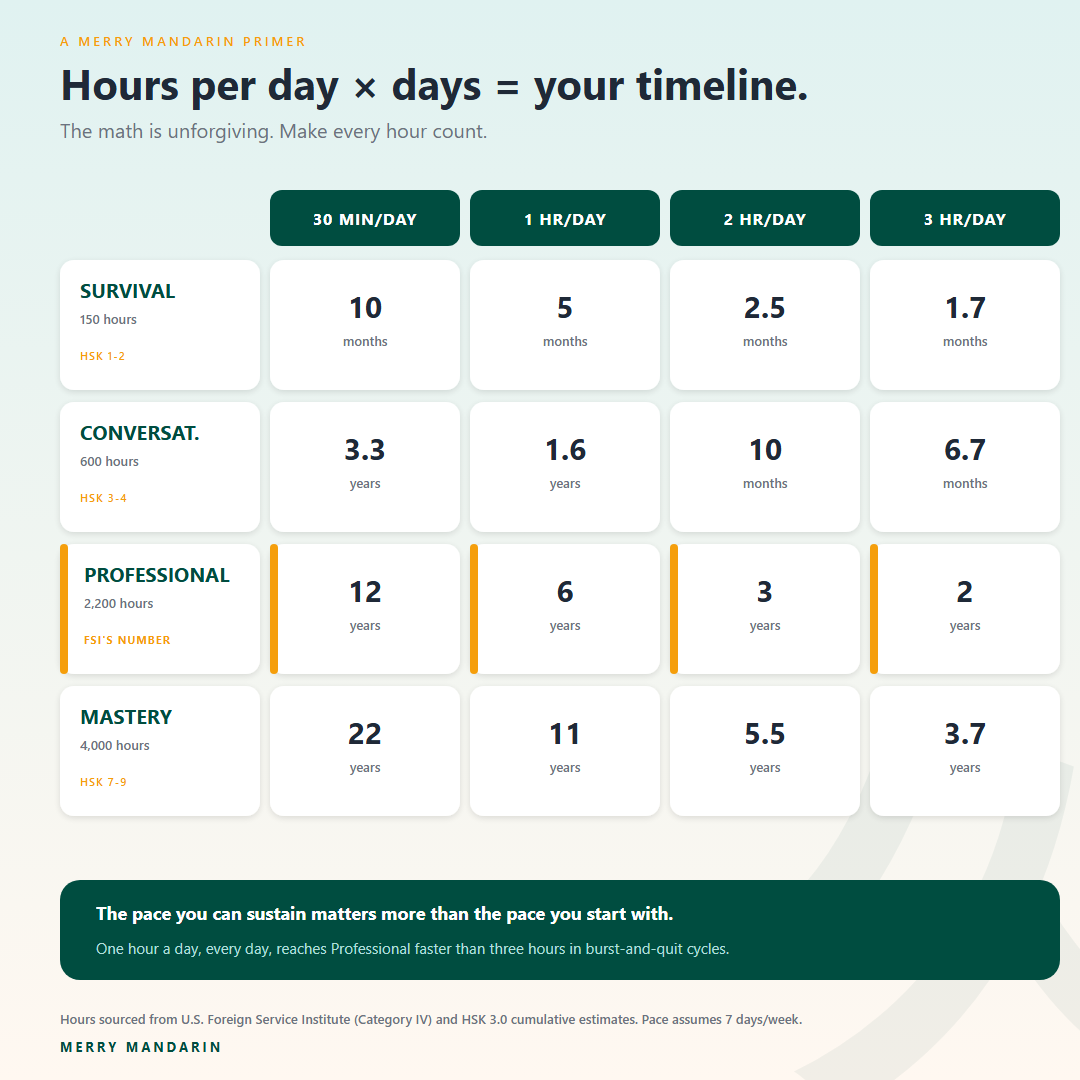
Once you have a tier, the math becomes simple, and it is the math that determines whether you finish. The Merry Mandarin time-to-fluency calculator takes your goal tier and your daily commitment and returns the date you reach it. Thirty minutes a day to Tier 2 is roughly three and a half years. One hour a day to Tier 2 is under two. Two hours a day to Tier 3 is about three years. The numbers are not flattering, but they are real, and the calculator's value is that it removes the fantasy from the equation.
The reason this matters more than enthusiasm is that Mandarin time to fluency is dominated by consistency, not intensity. A learner who does forty-five minutes every day for four years will pass a learner who does three hours every Saturday and nothing on weekdays, every time, without exception. Use the Merry Mandarin time-to-fluency calculator to find the daily number you can actually hold for a decade if you have to, and then commit to it.
Cut the hours-per-tier with structural accelerators
Mandarin does not get easier. The hours per tier do not shrink because you wish them to. But the hours can be made more productive: the ratio of rote re-learning to genuine acquisition can be shifted significantly with three structural choices. This is where most of the actual leverage lives.
The Merry Mandarin FSRS-5 review engine
The first accelerator is killing the re-learning tax. Most learners forget perhaps a third of what they study because their review schedule is built on intuition or, worse, on the old SM-2 algorithm that the original spaced-repetition apps shipped with two decades ago. The Merry Mandarin FSRS-5 review engine schedules reviews using the current state of the art in memory modeling, and on average requires up to 20% fewer reviews than SM-2 for the same retention. The algorithm also learns from your review patterns and can be finetuned to you specifically. Over 2,200 hours, a 20% reduction in review load is not a marginal improvement; it is hundreds of hours returned to you, hours you can spend on new acquisition rather than holding ground.
The Merry Mandarin Reading library
The second accelerator is the one nobody wants to hear, because it is slow and quiet: extensive comprehensible input. The long climb from Tier 2 to Tier 3, the slog from 600 to 2,200 hours, is the tier where vocabulary acquisition has to come from reading, because no flashcard deck contains the words you need next. The Merry Mandarin Reading library is a graded reading collection that meets you wherever you are on the ladder, from HSK 2 short stories through modern essays and classical excerpts. The principle is simple: read a lot, slightly below your comfort ceiling, with friction lowered enough that you keep going. Learners who add forty-five minutes a day of graded reading to their study routine routinely cut the Tier-2-to-Tier-3 climb by a third.
Track progress against the calculator and the Merry Mandarin HSK 1-6 course ladder
The final accelerator is not a feature. It is a habit: tracking the hours that count. The Merry Mandarin HSK 1-6 course ladder is the syllabus that matches the tier ladder above, with each HSK level mapped to its target vocabulary, character set, and grammar inventory. Logging hours against the calculator and the ladder turns the invisible road into a visible one. You stop asking how long does it take to learn Mandarin and start asking which sub-tier you are in this month, which characters you owe yourself before the next test, which fifteen-minute block of evening commute you can convert from passive listening to active review.
It also makes the realistic part bearable. When you can see that you are 312 hours into Tier 2 with 288 to go, the road feels finite. When you cannot see it, every plateau feels permanent.
The honest answer, restated
The honest answer to how long does it take to learn Mandarin is 2,200 hours to a working professional level, plus or minus your patience, your structural choices, and whether you live in a Mandarin-speaking environment. The dishonest answer is any number lower than 600 with the word "fluent" attached to it. Between those two numbers is the only useful question: which tier do you actually want, and what daily pace makes it real?
Use the Merry Mandarin time-to-fluency calculator to locate yourself on the ladder, then open the Merry Mandarin HSK 1-6 course ladder and start logging the hours that actually count. Merry Mandarin is built for this. Come learn with us!