
FIFA World Cup Mandarin: 22 Football Words in Chinese To Learn While Watching The Games
It is the summer of 2026 and the World Cup is mid-flight across sixteen cities in Canada, Mexico, and the United States, a tournament of 48 teams and 104 matches stretched across 39 days. In Taipei, every café television is tuned to it. You are sitting under a ceiling fan with a cold bottle of Taiwan Beer, watching Mandarin commentary scroll along the bottom of the screen faster than your eyes can land on any single character. Names you half-recognize blur past. Numbers you half-trust flash and vanish. And then you notice something: the same character keeps appearing on screen. Over and over. Three times in one sentence. It rides under the goalkeeper's name, sits inside the word for the stadium, repeats whenever the commentator gets excited.
That character is 球. And the moment you see it for what it is, the soup in front of you turns into a grid.
What are the most common football terms in Mandarin Chinese?
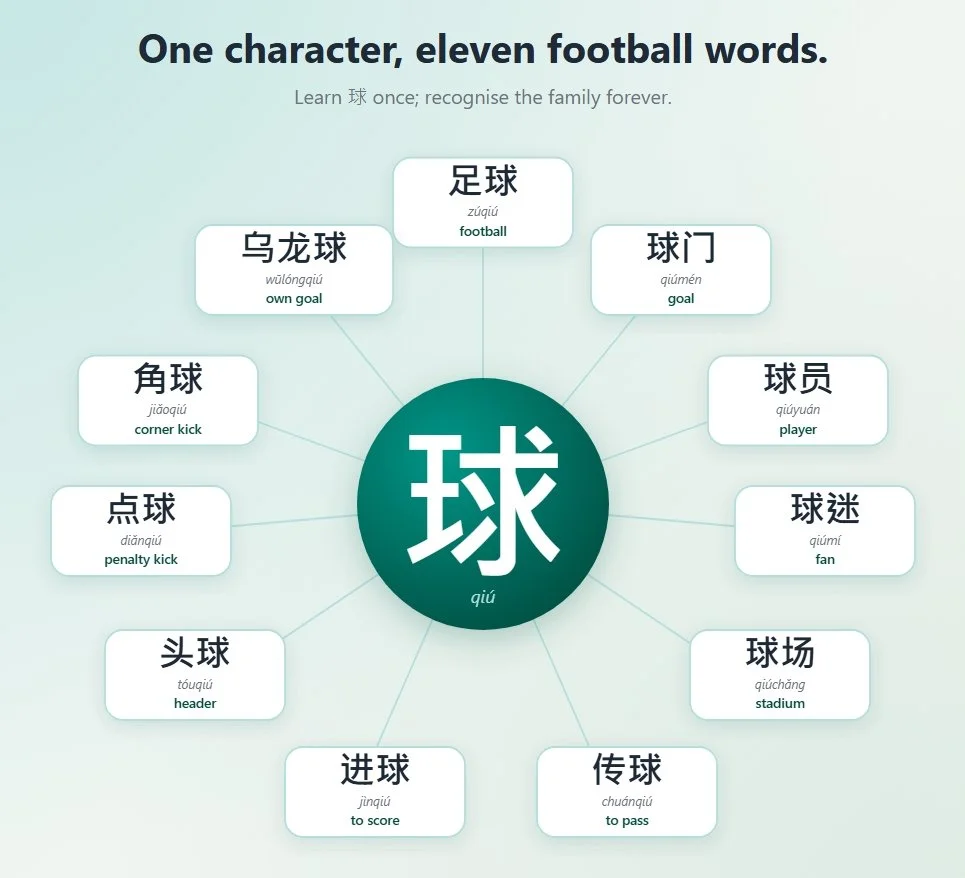
Football in Mandarin centres on two repeating characters. 球 (qiú, ball) appears in eleven core words including 足球 (football), 球门 (goal), 进球 (to score), 球员 (player), and 守门员 (goalkeeper). 门 (mén, door, used for the goal itself) sits inside four more, including 球门 and 射门 (to shoot at goal). Together, the two characters cover fifteen of the twenty-two words a Mandarin learner needs to follow a match. Learn those two first and the rest of the Mandarin football vocabulary arrives on its own.
This is the structural insight most vocabulary lists miss. Open any standard World Cup Mandarin primer and you will find twenty-two terms in alphabetical or topical order: player, fan, stadium, goal, goalkeeper, shoot, pass, kick, score, foul, offside, red card, yellow card. The learner dutifully tries to memorize 球员, 球迷, 球场, and 球门 as four separate facts, when they are really one repeating pattern with four different second characters. The Merry Mandarin component breakdown system is built on exactly this kind of clustering, which is how the pattern surfaces in the first place rather than staying buried under topical organization.
Learn 球 and 门 first; the rest of football Mandarin arrives on its own.
球 (qiú): the character that runs the whole pitch
球 means ball, and the radical on its left, 王 (the jade radical), tells you the etymology: it originally referred to a round piece of jade. By the time the ball arrived from Britain in the late nineteenth century, the character was sitting there waiting.
The pattern is almost mechanical. The sport itself is 足球 (zúqiú), foot-ball, the word Taiwan and the mainland both use for what Americans call soccer. American football is 美式足球; rugby is 橄榄球 (gǎnlǎnqiú), olive-ball, named for the shape. On the field, the player is 球员 (qiúyuán), ball-personnel. The fan is 球迷 (qiúmí), ball-obsessed. The stadium is 球场 (qiúchǎng), ball-arena. The team is 球队 (qiúduì), ball-squad. The shoes are 球鞋. The match is sometimes shortened to 球赛.
When the ball goes in, you have 进球 (jìnqiú), enter-ball — to score. When a player wins possession from the run of play, you hear 控球 (kòngqiú), control-ball. When the commentator wants to gush about technique, it is 球技 (qiújì), ball-skill. Even the league you have heard of, the Chinese Super League — full name 中国足球超级联赛, abbreviated 中超 — has 球 sitting at its centre.
Eleven words, one character. None of them needs to be memorized in isolation if you understand that 球 is the engine.
门 (mén): the goal hiding inside four more words
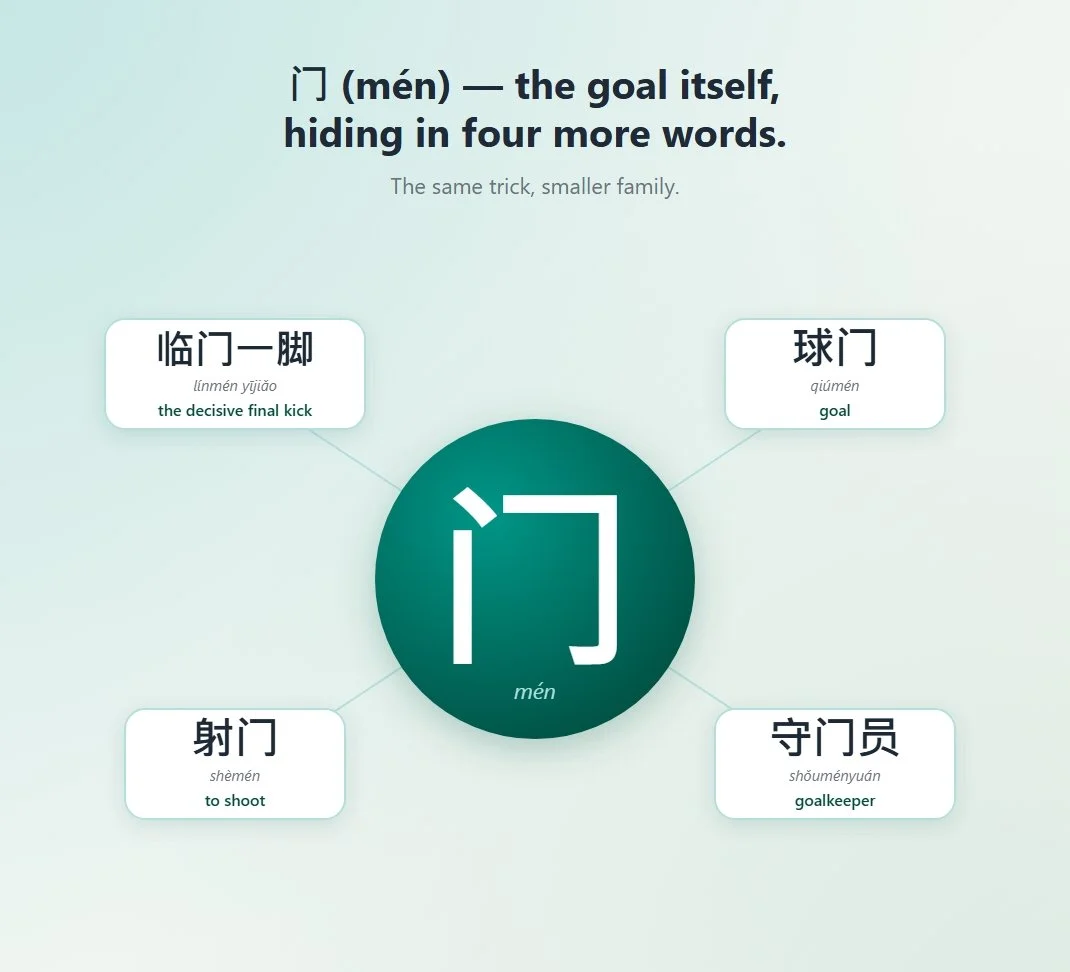
If 球 is the engine, 门 is the destination. The character means door or gate, which is exactly the metaphor English used too — we just stopped noticing. A goal in Mandarin is 球门 (qiúmén), ball-door. The structure itself, the posts and net, is also 球门 (Source: China Daily; Source: FluentU).
From there the family writes itself. The goalkeeper is 守门员 (shǒuményuán), guard-door-personnel — three characters that decompose into a perfect job description (Source: China Daily). To shoot at goal is 射门 (shèmén), shoot-door (Source: China Daily). And the phrase Chinese commentators reach for when a striker is poised one yard out with the whole net gaping is 临门一脚 (línmén yī jiǎo), at-the-door one kick: the decisive kick, the one that decides everything. It is colloquial rather than dictionary-formal, but you will hear it in the final ten minutes of any tight match.
That is four more words from one character. Combined with the eleven 球 words, you are at fifteen of twenty-two before you have learned a single verb. This is the first step in the pipeline: learn 球 (ball) and 门 (door → goal) — covers 15 of 22 words.
The verbs and rules: 踢, 传, 射, 进 and the cards that stop them
Now the gameplay. Step two in the pipeline is to add the action verbs (踢 kick, 传 pass, 射 shoot, 进 enter) — covers gameplay. These are the four verbs the commentary will live inside.
踢 (tī) is to kick, the foot-radical 足 on the left telling you everything. 传 (chuán) is to pass — the same character that means to transmit or to hand down, applied here to the ball moving between players. 射 (shè) is to shoot, the same shoot that lives inside 射门. 进 (jìn) is to enter, which is what the ball does to the net when 进球 happens. Four verbs, all one character each, all carrying their meaning visibly on the surface.
Once the ball is moving, you need the rules — step three, cards and rules (红牌 red card, 黄牌 yellow card, 越位 offside, 犯规 foul). The cards are easy: 红 (hóng) is red, 黄 (huáng) is yellow, 牌 (pái) is card. 红牌 and 黄牌. The referee waves them and the commentator says the word and you know what happened without subtitles. 越位 (yuèwèi) is offside, literally over-position, which is exactly what offside is. 犯规 (fànguī) is to foul, violate-rule, a compound that means precisely what it says.
That is twenty words. You are nearly there.
Oolong balls, hat-tricks, and dark horses: the commentary lexicon
The final step in the pipeline is to add cultural phrases (乌龙球 own goal, 帽子戏法 hat-trick, 黑马 dark horse, 临门一脚 the decisive kick) — covers commentary color. These are the words that separate a learner who is parsing the score from a learner who is parsing the story.
乌龙球 (wūlóngqiú) is own goal, and it is the most charming etymology in the football lexicon. It looks like it should mean black-dragon-ball, which is poetic but wrong. The phrase is a phono-semantic match coined by Hong Kong sports journalists in the 1960s, who picked 乌龙 because the Cantonese pronunciation resembled the English phrase "own goal" (Source: Wiktionary; Source: eChineseLearning). The characters mean nothing about football; they were chosen for sound. Now every Mandarin commentator on earth uses them.
帽子戏法 (màozi xìfǎ), hat-trick, is a calque rather than a phonetic match — hat-trick translated character by character: hat-trick. The original term comes from English cricket in 1858, when bowler H. H. Stephenson took three wickets in three consecutive deliveries and his fans passed a hat around to buy him a present (Source: Wikipedia). The Mandarin phrase carries the cricket-pitch logic into football intact, and it is the standard term used in the Chinese Super League, where 101 players have scored three or more goals in a single match since the league's founding in 2004 (Source: Wikipedia).
黑马 (hēimǎ), dark horse, is another calque, borrowed from English horse-racing slang and now used in Chinese sports, business, and election commentary alike (Source: China Daily). The team nobody expected to make the quarter-finals is a 黑马. The semifinal upset is a 黑马 story. You will hear it three times a tournament, minimum.
And 临门一脚, already introduced, completes the set. Four phrases that no decomposition will give you for free, because their meaning lives in their history rather than their parts. These are the ones to memorize the slow way, with stories attached.
Reading a real headline, character by character
Try one. A typical Mandarin sports headline during the group stage might read: 进球! 球员临门一脚, 守门员扑救失败.
Goal! Player at-the-door one kick, goalkeeper save fail. Translated cleanly: Goal! The striker's decisive kick beat the goalkeeper's save. Six of the eight content characters belong to the 球 or 门 family. The other two — 扑救 (pūjiù), to save by diving — are vocabulary you only need once you can already follow the sentence.
This is what grouped vocabulary does. It compresses what looks like twenty-two unrelated facts into a structure with two anchor characters and a small fringe of verbs and idioms. The same approach scales: HSK 1 to HSK 6, 322+ radicals, 13,000+ words, each one slotting into a family rather than landing as a standalone item. The Merry Mandarin Dictionary handles the lookup with classifiers, usage notes, common confusions, and human-written example sentences for all 14,000 entries, so when you hit a word like 扑救 mid-headline you get the football-specific sense rather than a generic gloss.
The Chinese football terms covered here are barely the surface. Once you have 球 and 门 down, the rest of the sports section opens up — 篮球 basketball, 排球 volleyball, 棒球 baseball, all built on the same root. The structure is the lesson; the words are the reward.
Pick up the 球 and 门 families during this tournament, which runs from June 11 to July 19, and let the Merry Mandarin FSRS-5 review engine keep them warm through the final. By the time the next World Cup kicks off, you will be reading the headline before the commentator finishes the sentence. The Merry Mandarin HSK 1–6 course ladder is built for exactly this kind of pattern-first learning.