
Why Gamified Language Learning Apps Stall You at Beginner Chinese
You have held a four-hundred-day streak, you can order 牛肉面 without hesitation, and you can introduce yourself to a stranger and ask for the bill — and yet the news headline above the noodle shop still looks like a wall of pictograms, and somewhere around month nine you started to suspect the green owl was the only one in the building congratulating you. The streak, it turns out, had been measuring the wrong thing all along.
Why do gamified language apps stop working at the intermediate level?
Gamified language apps stop working at the intermediate level because they optimize for streak mechanics and daily session count rather than for the structural depth Mandarin requires past HSK 2. Tapping multiple-choice answers teaches recognition, not decomposition. To move past parroting, a learner needs to break characters into their radical components, disambiguate near-synonyms such as 认识 and 知道, and review with an explicit memory scheduler — three things that matching-pair drills, by design, do not do.
The Duolingo Burnout pattern at the Advanced Fluency Plateau
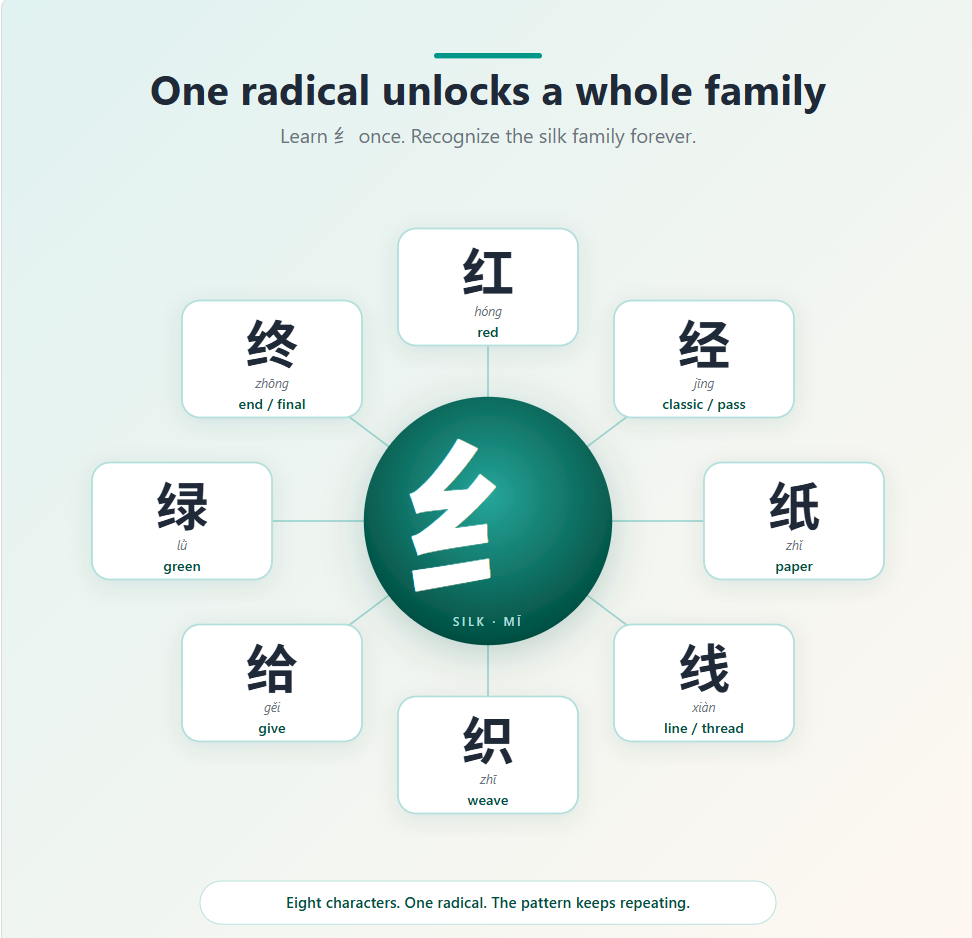
The structural problem becomes visible the moment you look at the vocabulary curve. HSK 2 sits at roughly 300 words (Source: ImproveMandarin/Hanban) and HSK 4 reaches around 1,200 (Source: HSKLord), but the gap between those two waypoints is less a slope than a cliff. Up to HSK 2, you can fake comprehension well enough by pattern-matching four English options on a screen; past it, you have to actually parse the 红 hiding inside 经, and decide whether the verb you want is 认识 — to be acquainted with someone — or 知道, to know a fact.
Streak-driven apps do not surface that kind of distinction, and structurally they cannot, because the pedagogical loop is built around the metric the company reports to its investors: more than fifty million daily active users, with over ten million on year-plus streaks (Source: Duolingo Q3 FY2025 SEC 8-K). The product, in other words, is daily active use, and the optimization target is retention of the user rather than retention of the vocabulary.
This is the place where Duolingo Burnout meets the Advanced Fluency Plateau. You are showing up, you are tapping, the little graph stays comfortingly green, and yet the words refuse to settle into the kind of memory that lets you read 红楼梦 in the original or follow a Taiwanese news anchor at normal speed. Roediger and Karpicke established back in 2006 that active recall outperforms passive re-exposure for long-term retention, and matching-pair drills, for all their satisfying animations, are passive re-exposure with extra confetti. Past beginner, your streak measures discipline; the language measures comprehension. They are no longer the same project.
What gets you over the cliff is not more gamification but a different shape of practice altogether — one that treats Mandarin as the writing system it actually is, rather than a vocabulary list to be tapped through one screen at a time.
Step 1 — INPUT (Content Ingestion)
You cannot review your way to fluency from a vocabulary list, however cleverly the deck is shuffled. Sooner or later you need text: graded text at first, then real text, then the news headline you could not read last year. Watch videos on Youtube by Mandarin-speaking creators you find interesting, and extract the vocabulary you don’t know from their transcripts.
The Merry Mandarin Reading library handles input (content ingestion) by offering graded passages across HSK 1 through 6 , with tap-to-dictionary support on every character; tap 经, head to the decomposition section and the 纟 silk radical surfaces underneath it, tap 认识 and you can see, at a glance, where it splits from 知道. Reading stops being a brick wall and starts behaving like a tool you can sharpen, because you ingest meaning in context — which, as the cognitive-science literature has been arguing for decades, is the form in which the brain prefers to receive Chinese.
Running alongside is the Merry Mandarin HSK 1–6 course ladder, which keeps your structured vocabulary roughly in step with whatever you happen to be reading at the moment, so the era of grinding decks for words you will never meet in a sentence is, mercifully, behind you.
Step 2 — REVIEW (Flashcards)
Reading without review is a sieve, and review without good scheduling is a slog; both can be true at once, which is why so many intermediate learners spend a long time trapped between the two.
The Merry Mandarin FSRS-5 review engine schedules your flashcards using FSRS, the open-source spaced-repetition algorithm Jarrett Ye published at ACM SIGKDD (Source: Expertium Benchmark) and which Anki adopted officially in November 2023; users report between 20 and 30 percent fewer reviews than the older SM-2 algorithm for the same retention target (Source: Matt vs Japan / Anki FAQs). Fewer reviews for the same outcome is a substantial gift when your study budget consists of whatever fragments of time you can carve out between meetings and the commute home.
Scheduling alone, however, will not tell you why 认识 and 知道 part company, which is where the Merry Mandarin Dictionary comes in — a Comprehensive Chinese Dictionary built around 14,000 entries, each one carrying classifiers, usage notes, common confusions, and human-written example sentences rather than the bare gloss most apps ship with. When a review card surfaces 知道, the Comprehensive Chinese Dictionary entry shows you, in context, exactly where 认识 would be wrong instead, which turns synonym disambiguation from a guessing game into something a great deal closer to comprehension.
The dictionary includes a component breakdown system, which traces characters back through their constituent parts. Once you have absorbed that 红, 经, and 纸 all share the silk radical 纟, you stop memorizing characters one by one and start reading the logic that links them together.
All of this works offline, too. The Merry Mandarin offline speech engine, grades your pronunciation on the device itself — useful on the train, useful on a flight, useful for anyone who would rather not route their voice through a cloud service for an evening study session.
Step 3 — PRODUCTION (Real-world application with tandem partners)
Input and review build the engine; production is what proves the engine actually runs. It is also the step no application should pretend to fully own, because production happens between two people, in real air, and a screen is the wrong venue.
Production (real-world application with tandem partners found externally) means finding a language partner on, joining a Taipei language exchange, or calling a friend's cousin in Taichung — and then using the vocabulary you have actually retained, out loud, in sentences another human being can hear and answer. It also means voice memos to yourself describing your morning while you wait for the kettle, and a daily journal of three or four sentences when nothing more ambitious will fit.
The Merry Mandarin Reading library and the Merry Mandarin review engine load the chamber; a real conversation is what pulls the trigger. Skip the conversation and the words stay theoretical forever — which, not coincidentally, is exactly the trap streak apps are content to leave you in.
What the beginner-to-advanced arc actually looks like
学, 习, 用 — learn, practice, use; input, review, production. Streak apps offer a thin version of the first step and almost nothing of the other two, which is why the month-nine plateau feels so much like month three with more noise.
The new HSK 3.0 standard, issued by China's Ministry of Education in March 2021 and implemented that July, expanded the examination into nine levels (Source: ChineseFor.Us / China Education Center); but whether you are targeting HSK 6 on the old scale or HSK 7–9 on the new one, the shape of the curve is the same. At some point, tapping is no longer enough. You have to read, you have to schedule your review, and you have to speak.
Merry Mandarin is built for the whole arc rather than the beginner pop-quiz, and our Reading library, the review engine, the Comprehensive Chinese Dictionary, and the offline speech engine are designed to work as a single pipeline, so that the practice you put in today actually surfaces in the conversation you have next month.