
All 45 European Countries in Chinese — and the 7 Characters Behind Most of Them
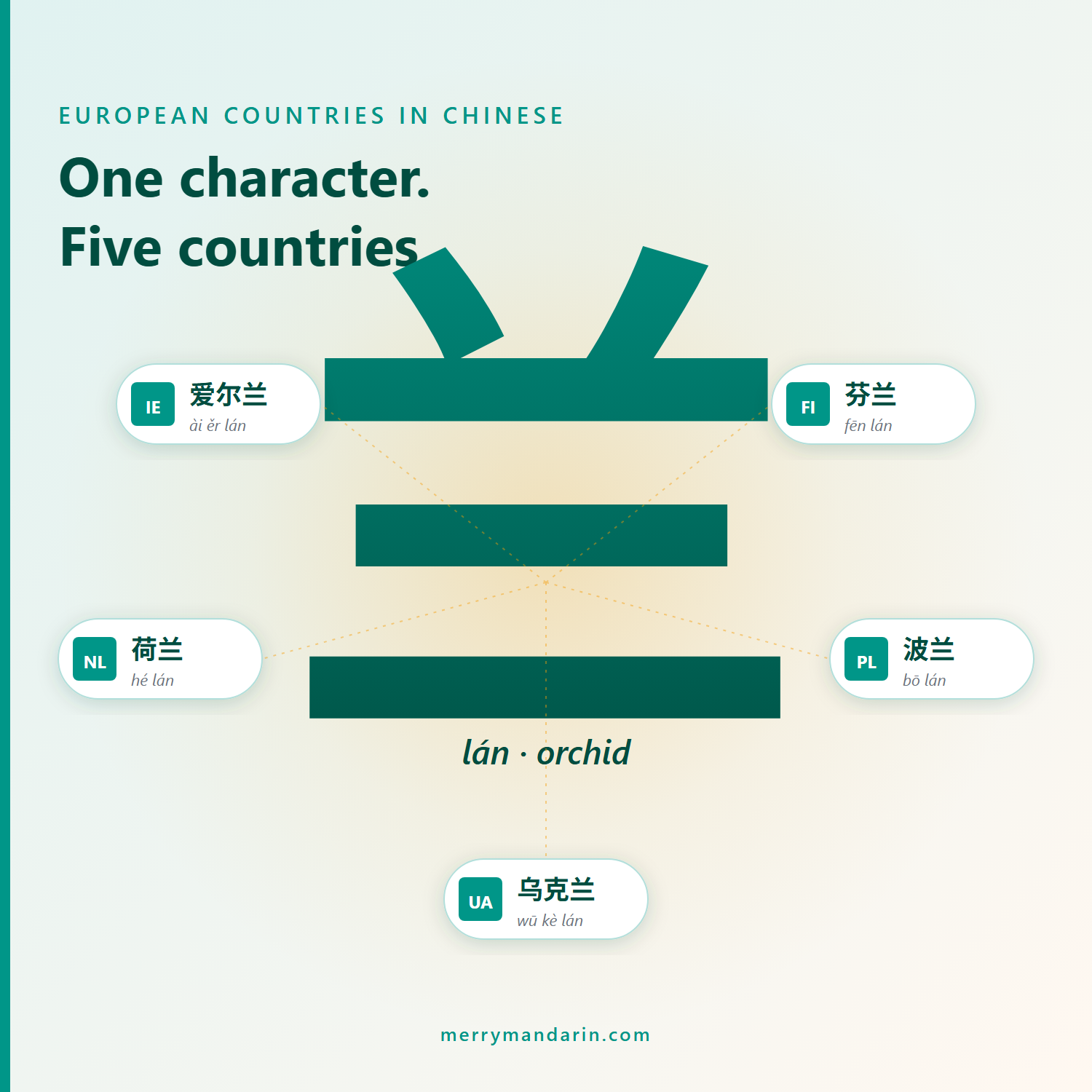
You can sit in a Shanghai café with a state-news broadcast on the screen behind the bar and watch the names of European countries scroll past in a strip along the bottom. 爱尔兰. 芬兰. 荷兰. 波兰. 乌克兰. Five different countries, five different European stories, and one character — 兰 (lán), the character for orchid — sitting in all of them. Once you see it, you cannot unsee it. And once you can read it, you can pronounce roughly an eighth of Europe in Mandarin without having to learn five new names from scratch.
This is the structural insight that makes 45 European countries in Chinese far less work than it sounds. Most learners approach the list as a wall of phonetic transliterations — 葡萄牙, 列支敦士登, 斯洛文尼亚 — and the names look impenetrable. They are not. They are seven recurring characters wearing forty-five different costumes, with a small handful of beautifully direct translations stitched in for variety.
This guide gives you all 45 European countries in Chinese with pinyin, the etymology behind the names worth knowing, the recurring characters that unlock the rest, and the single-character abbreviations Chinese newspapers use when they do not have room for the full name. By the end you will read the strip along the bottom of that café television differently.
How do you say European countries in Chinese?
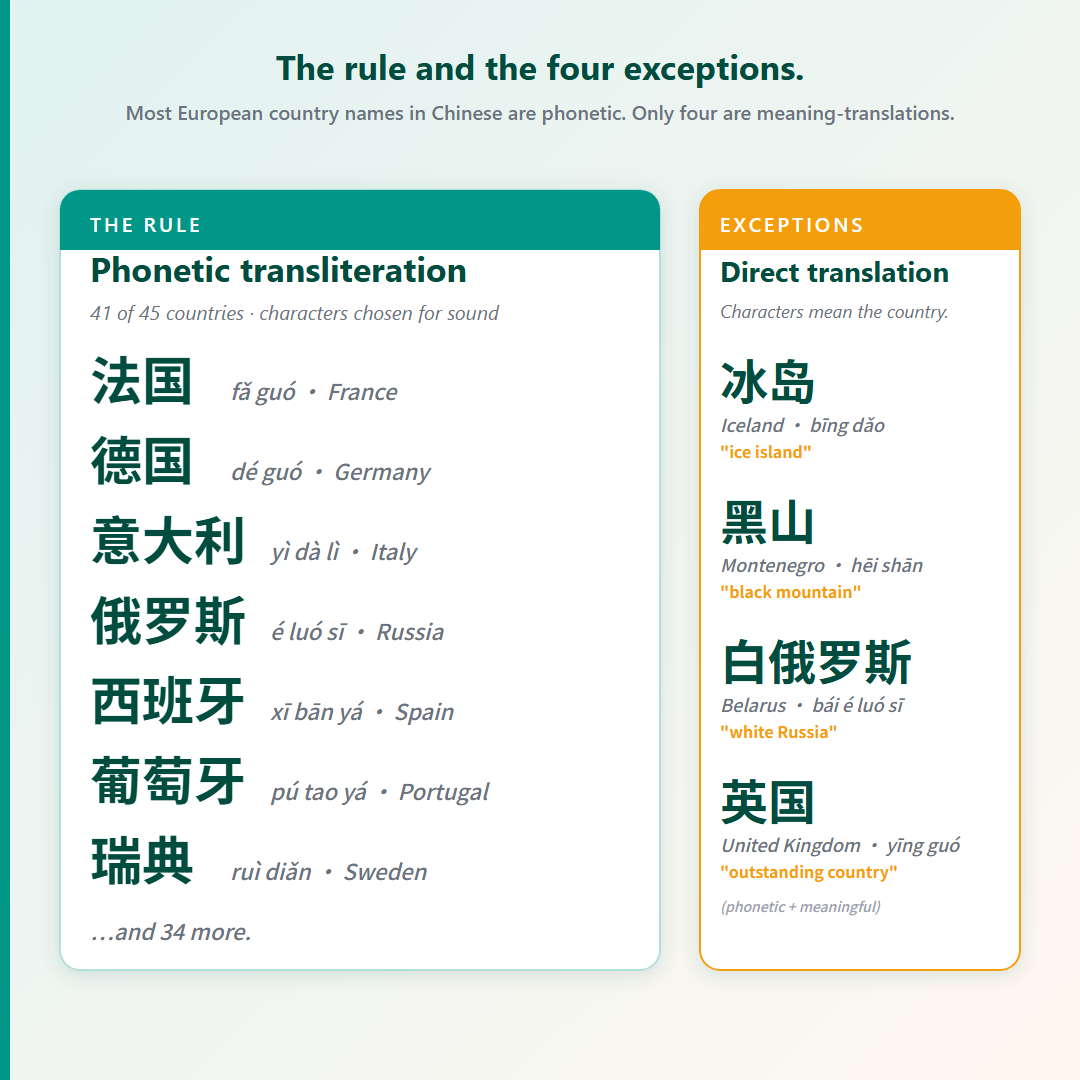
Most European country names in Mandarin are phonetic transliterations — Chinese characters chosen for their sound rather than their meaning. France in Chinese is 法国 (fǎ guó), Germany in Chinese is 德国 (dé guó), Italy in Chinese is 意大利 (yì dà lì), Russia in Chinese is 俄罗斯 (é luó sī). A small number are direct translations, where the characters mean what the country's name means in English: Iceland in Chinese is 冰岛 (bīng dǎo), literally ice island; Montenegro in Chinese is 黑山 (hēi shān), literally black mountain. Seven characters recur across the 45 names so often that learning them once unlocks roughly thirty country names you would otherwise treat as separate vocabulary items.
Why Chinese country names work the way they do
For most of the twentieth century, the standard for transliterating foreign names into Chinese was set by Xinhua News Agency, whose reference work — *世界人名翻译大辞典*, the Comprehensive Dictionary of Translations of World Personal Names — fixed the characters that newspapers and textbooks would use for every foreign country, city, and politician. The principle was not invention but convergence. Once Xinhua chose 法国 for France, every textbook and every news ticker used 法国, and the alternatives quietly died.
The character set was not random. Xinhua's transliterators preferred characters that were neutral or flattering in tone — 利 (advantage), 德 (virtue), 美 (beauty) — and avoided characters with negative associations or unusual readings. This is why Britain in Chinese is 英国 (yīng guó), where 英 means "outstanding," a generous gloss on the "Eng-" of England. France is 法国, shortened from the earlier 法兰西, where 法 means "law." Germany is 德国, where 德 means "virtue." Three nineteenth-century powers, three aspirational characters. The pattern is not coincidence; it is editorial policy from a country that thought hard about the names it chose to use.
A handful of European countries got a different treatment entirely. Iceland, Montenegro, and Belarus are not phonetic at all — their Chinese names translate the meaning of the foreign name directly. 冰岛 is "ice island." 黑山 is "black mountain," a literal calque of Montenegro's Italian root, *Monte Negro*. 白俄罗斯 is "white Russia," which is what *Belarus* means in Slavic. These four exceptions — the fourth being the ambiguous case of 英国, where 英 is technically phonetic but carries real meaning — are worth memorizing first because they are the only places in Europe where the characters mean what the country means.
All 45 European countries in Chinese, region by region
The list below sweeps from west to east, matching the geographic flow of the Merry Mandarin Europe video. Each entry gives the flag, the country, the Chinese name, the pinyin with tones, and — where it earns the space — a line of etymology. If you want the printable wall version, the poster at the end of the article has all 45 grouped by region on a single sheet.
British Isles and the Atlantic
🇬🇧 United Kingdom in Chinese is 英国 (yīng guó). The character 英 means "outstanding" — a flattering phonetic loan for the "Eng-" of England. One of only three European countries that get the 国 ("country") suffix, alongside France and Germany; those three are the European powers Chinese settled on a one-syllable nickname for early enough that the abbreviation became the standard.
🇮🇪 Ireland in Chinese is 爱尔兰 (ài ěr lán). The first appearance of 兰 (lán), the orchid character. Keep counting; you will see it four more times before the article is over.
Nordic countries in Mandarin
🇮🇸 Iceland in Chinese is 冰岛 (bīng dǎo) — one of only three direct translations in the entire European list. 冰 is ice, 岛 is island. No phonetic detour at all.
🇳🇴 Norway in Chinese is 挪威 (nuó wēi). A clean two-syllable phonetic loan.
🇸🇪 Sweden in Chinese is 瑞典 (ruì diǎn). 瑞 means "auspicious," another of Xinhua's flattering picks.
🇫🇮 Finland in Chinese is 芬兰 (fēn lán). The second 兰. 芬 means "fragrance" — orchid and fragrance, an accidental garden.
🇩🇰 Denmark in Chinese is 丹麦 (dān mài). 丹 is "red" or "cinnabar"; 麦 is "wheat." Two characters, neither carrying a meaning related to Denmark itself.
Benelux
🇳🇱 Netherlands in Chinese is 荷兰 (hé lán). The third 兰. 荷 is "lotus" — another flower, by sheer phonetic accident. Dutch in Chinese is 荷兰语.
🇧🇪 Belgium in Chinese is 比利时 (bǐ lì shí). The first appearance of 利 (lì), the "advantage" character — it will return in four more country names before this section is done.
🇱🇺 Luxembourg in Chinese is 卢森堡 (lú sēn bǎo). Three characters, three syllables, none of them carrying meaning beyond the sound.
France and the microstates
🇫🇷 France in Chinese is 法国 (fǎ guó), short for the older 法兰西. 法 means "law," which became the diplomatic shorthand for France in Chinese writing: 中法 (China–France), 法语 (the French language), 法国人 (a French person). Every productive word about France in Mandarin runs through this one character.
🇲🇨 Monaco in Chinese is 摩纳哥 (mó nà gē). The 哥 at the end is the same character that closes several country names across the Americas; in Europe it appears only here.
🇦🇩 Andorra in Chinese is 安道尔 (ān dào ěr).
Iberia and the Mediterranean
🇵🇹 Portugal in Chinese is 葡萄牙 (pú tao yá). The characters literally mean "grape tooth" — a pure phonetic coincidence that has been delighting Mandarin learners for a century. 葡萄 happens to be the standalone Chinese word for "grape." There is no connection to Portuguese wine. The characters were chosen for sound and the rest is a happy accident.
🇪🇸 Spain in Chinese is 西班牙 (xī bān yá). 牙 ("tooth") sits at the end of both Spain and Portugal — the only two countries in Europe that share that particular character.
🇮🇹 Italy in Chinese is 意大利 (yì dà lì). Notice the 利. Three characters, three syllables, very clean.
🇲🇹 Malta in Chinese is 马耳他 (mǎ ěr tā).
🇻🇦 Vatican City in Chinese is 梵蒂冈 (fàn dì gāng). 梵 is a character Chinese uses almost exclusively for Sanskrit and Buddhist borrowings — its presence here is a quiet linguistic tribute to the Vatican's religious weight, even when the underlying religion is different.
🇸🇲 San Marino in Chinese is 圣马力诺 (shèng mǎ lì nuò). 圣 ("holy" or "saint") translates the "San," then phonetic takes over.
Alpine and Central Europe
🇨🇭 Switzerland in Chinese is 瑞士 (ruì shì). 瑞 again — the same auspicious character that opens Sweden.
🇱🇮 Liechtenstein in Chinese is 列支敦士登 (liè zhī dūn shì dēng). Five characters; almost the longest country name in the European list. Liechtenstein simply has too many syllables to compress.
🇦🇹 Austria in Chinese is 奥地利 (ào dì lì). 利 again — the fourth country in the European list with that character at the end.
🇩🇪 Germany in Chinese is 德国 (dé guó). 德 means "virtue," which has made the character productive in ways that go far beyond the country name itself: 德语 is the German language, 中德 is the China–Germany shorthand in diplomatic writing, 德国制造 ("Made in Germany") is a phrase Chinese consumers recognize on sight.
🇨🇿 Czech Republic in Chinese is 捷克 (jié kè). 捷 means "swift" or "victorious." One of the shortest country names in Europe.
🇵🇱 Poland in Chinese is 波兰 (bō lán). The fourth 兰. 波 is "wave."
🇸🇰 Slovakia in Chinese is 斯洛伐克 (sī luò fá kè).
🇭🇺 Hungary in Chinese is 匈牙利 (xiōng yá lì). The fifth and final country with 利 at the end. Hungary also closes the set of three "tooth" countries: Hungary, Spain, and Portugal all carry 牙 inside their Chinese names, by pure phonetic accident.
The Balkans
🇸🇮 Slovenia in Chinese is 斯洛文尼亚 (sī luò wén ní yà).
🇭🇷 Croatia in Chinese is 克罗地亚 (kè luó dì yà).
🇧🇦 Bosnia and Herzegovina in Chinese is 波斯尼亚和黑塞哥维那 (bō sī ní yà hé hēi sài gē wéi nà). The longest country name in Europe, by a wide margin. The 和 sitting in the middle is the Chinese word for "and" — joining Bosnia to Herzegovina the same way English does.
🇷🇸 Serbia in Chinese is 塞尔维亚 (sài ěr wéi yà).
🇲🇪 Montenegro in Chinese is 黑山 (hēi shān) — the second direct translation in the European list. 黑 is "black," 山 is "mountain." The Chinese name is a literal calque of the country's Italian root, Monte Negro. Of all forty-five European countries, this is the only one in the southern half of the continent that gets a meaning-translation instead of a phonetic one.
🇲🇰 North Macedonia in Chinese is 北马其顿 (běi mǎ qí dùn). 北 ("north") is meaning-translation; the rest is phonetic.
🇦🇱 Albania in Chinese is 阿尔巴尼亚 (ā ěr bā ní yà).
🇬🇷 Greece in Chinese is 希腊 (xī là). One of the shortest country names in the list — two characters, two syllables. 腊 originally referred to a winter sacrifice in classical Chinese, kept here purely for sound.
🇨🇾 Cyprus in Chinese is 塞浦路斯 (sài pǔ lù sī).
Eastern Europe, the Baltics, and Russia
🇧🇬 Bulgaria in Chinese is 保加利亚 (bǎo jiā lì yà).
🇷🇴 Romania in Chinese is 罗马尼亚 (luó mǎ ní yà). The opening 罗马 is also the standalone Mandarin word for "Rome." The connection is not accidental: in classical European geography, Romania meant "land of the Romans," and the Chinese name preserves that thread.
🇲🇩 Moldova in Chinese is 摩尔多瓦 (mó ěr duō wǎ).
🇺🇦 Ukraine in Chinese is 乌克兰 (wū kè lán). The fifth and final 兰. That is the complete set: Ireland, Finland, Netherlands, Poland, Ukraine. Learn one character; pronounce five countries.
🇧🇾 Belarus in Chinese is 白俄罗斯 (bái é luó sī) — the third direct translation. 白 is "white," 俄罗斯 is "Russia." Belarus literally means "white Russia" in Slavic, and Chinese preserves the structure exactly.
🇱🇹 Lithuania in Chinese is 立陶宛 (lì táo wǎn).
🇱🇻 Latvia in Chinese is 拉脱维亚 (lā tuō wéi yà).
🇪🇪 Estonia in Chinese is 爱沙尼亚 (ài shā ní yà).
🇷🇺 Russia in Chinese is 俄罗斯 (é luó sī). The single most important country name to know in this whole list, and the source of the diplomatic shorthand 中俄 (China–Russia). Notice that 罗斯 also closes out Belarus — Belarus is, after all, just 白 ("white") plus 俄罗斯 ("Russia").
The seven characters that unlock dozens of European country names
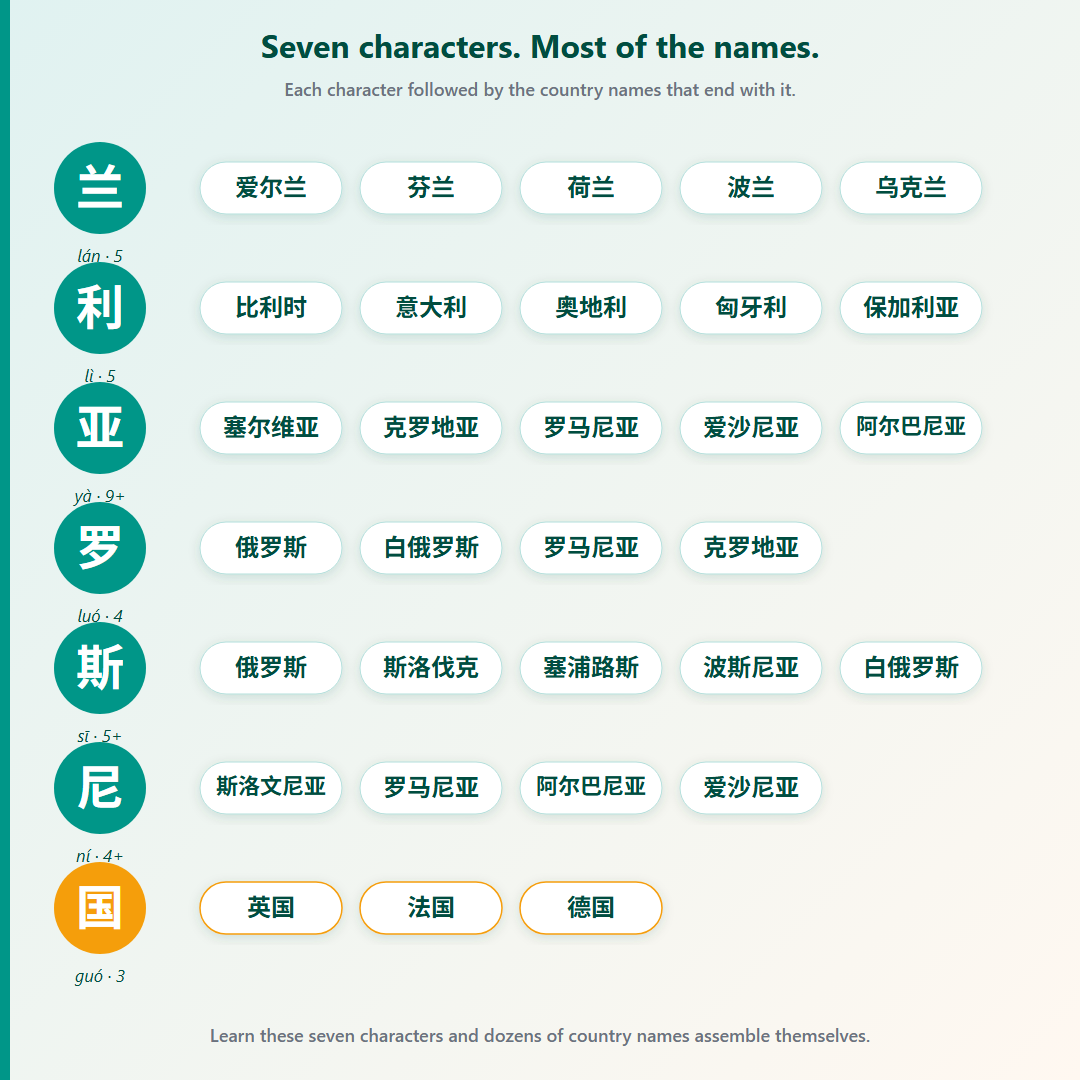
Forty-five names sounds like a heavy memorization load. It is not. Seven recurring characters carry most of the weight. Learn the characters, and the country names assemble themselves.
兰 (lán) — orchid. Sits at the end of five country names: 爱尔兰 (Ireland), 芬兰 (Finland), 荷兰 (Netherlands), 波兰 (Poland), 乌克兰 (Ukraine). Once you can read 兰, the "-land" suffix in European names becomes a sound you already know.
利 (lì) — advantage. Sits at the end of five country names too: 比利时 (Belgium), 意大利 (Italy), 奥地利 (Austria), 匈牙利 (Hungary), 保加利亚 (Bulgaria). This is Xinhua's quiet favorite — a neutral, slightly flattering character that fits a lot of European phonetic patterns ending in "-ly," "-ria," or "-gary."
亚 (yà) — used at the end of country names whose English form ends in "-ia." It closes Slovenia, Croatia, Serbia, Albania, Bulgaria, Romania, Estonia, Latvia, and Bosnia, among others. The single most productive country-name-ending character in modern Mandarin.
罗 (luó) — appears in Russia (俄罗斯), Belarus (白俄罗斯), Romania (罗马尼亚), and Croatia (克罗地亚). The "-r-" or "-ro-" sound across Slavic and Romance names.
斯 (sī) — appears in Russia, Belarus, Cyprus, Slovakia, Bosnia, and several country names elsewhere on the map. The Chinese transliterator's all-purpose "-s" sound.
尼 (ní) — Slovenia, Albania, Romania, Estonia, and others. The standard "-ni-" or "-ne-" filler.
国 (guó) — country. Sits at the end of only three European country names — 英国, 法国, 德国 — which is itself the historical fact. Britain, France, and Germany were the European powers China interacted with most often through the nineteenth and twentieth centuries, and 国 marks the names that became diplomatic shorthand early enough to stick.
Chinese country name abbreviations: the single-character shorthand newspapers use
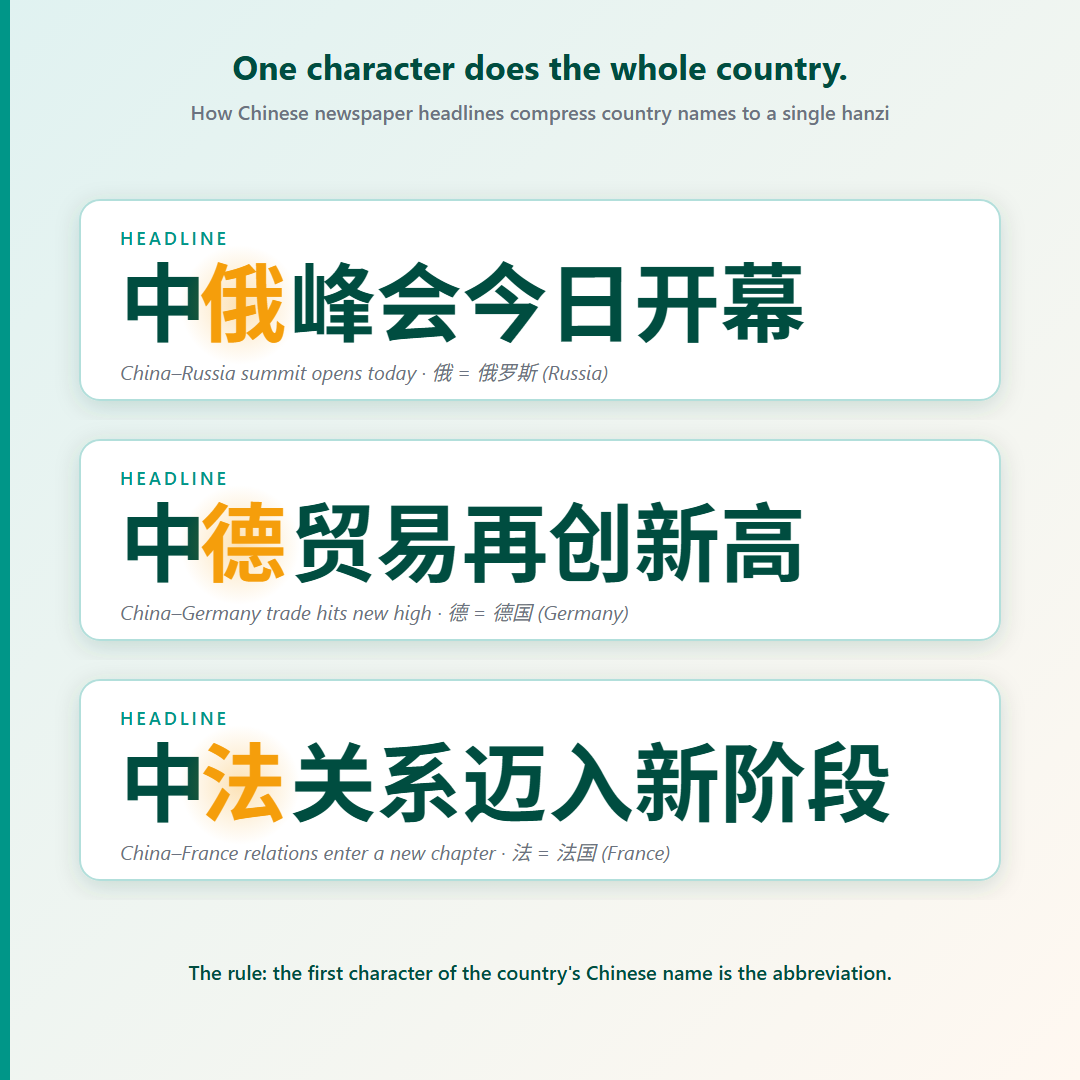
This is the section nobody teaches and every intermediate Mandarin learner needs. Open a Chinese newspaper and you will not see 中华人民共和国与法兰西共和国 spelled out as the subject of a headline. You will see 中法 (China–France), three syllables shorter. The rule is straightforward: the first character of the country's Chinese name doubles as the country's one-character abbreviation in diplomatic and journalistic writing. Once you know this, half of the People's Daily front page becomes legible.
The historically important abbreviations are worth memorizing as a set:
- 英 for Britain — 中英关系 (China–UK relations), 英语 (English language), 英镑 (British pound).
- 法 for France — 中法 (China–France), 法语 (French language), 法国人 (a French person).
- 德 for Germany — 中德 (China–Germany), 德语 (German language), 德国制造 ("Made in Germany").
- 意 for Italy — 中意 (China–Italy), 意语 or 意大利语 (Italian language).
- 俄 for Russia — 中俄 (China–Russia), 俄语 (Russian language), 俄罗斯人 (a Russian person).
- 西 for Spain — 中西 (China–Spain), 西语 or 西班牙语 (Spanish language). 西 alone is ambiguous because 西 also means "west," so context determines which.
- 葡 for Portugal — 中葡 (China–Portugal), 葡萄牙语 (Portuguese language).
- 荷 for the Netherlands — 中荷 (China–Netherlands), 荷兰语 (Dutch).
- 希 for Greece — 中希 (China–Greece), 希腊语 (Greek).
- 瑞 for Sweden and Switzerland — both. Context usually disambiguates, but in writing where both could appear, the full name is used.
A few countries break the rule. The Czech Republic in news writing is sometimes abbreviated 捷 (from 捷克), Vatican City stays as 梵蒂冈 because there is no graceful one-character compression, and the longest names — Bosnia and Herzegovina, Liechtenstein — get spelled out in full because nobody has agreed on a shorthand worth using.
How to actually memorize 45 European country names in Mandarin
The list above is forty-five separate facts, but the work is not forty-five hours. The work is learning the seven recurring characters once and then letting the country names assemble themselves around the characters you already know. This is exactly the principle the Merry Mandarin Component breakdown system is built on: characters cluster, and clusters are easier to learn than items.
A pipeline that works, in order:
1. Learn the four meaning-bearing names first — 冰岛, 黑山, 白俄罗斯, and the meaningful gloss inside 英国. These are the only European country names where the characters carry semantic weight, so they anchor the rest of the list.
2. Learn 兰, 利, 亚, 罗, 斯, 尼, 国 — the seven characters that close out the majority of country names. Each one is a single hanzi, and most learners already know at least 国 and 亚 from elsewhere.
3. Learn the abbreviations — 英, 法, 德, 意, 俄, 西, 葡, 荷, 希. Nine characters, each of which doubles as the country's first character. You are not adding nine new things; you are noticing that the first character of each country name is, itself, the country.
4. Drill the remaining twenty-odd phonetic names with spaced repetition. A well-tuned review schedule turns each name into a few minutes of total study time, spread across roughly two weeks.
The Merry Mandarin country quiz in our app drills these forty-five names with tone-coloured pinyin and a region map; the recurring characters are surfaced as their own component cards so the pattern recognition happens automatically rather than after you have already brute-forced the list.
Download the printable 45-country wall poster
The full list with flags, hanzi, pinyin, and regional colour-coding is available as a free printable wall poster. It prints crisp at A3 and stays legible at A4. Useful on a study wall, taped inside the door of a language-learning notebook, or pinned above a desk during a Mandarin reading sprint.
Download the 45 European countries in Chinese wall poster (PNG)