Should I Learn Traditional or Simplified Chinese? It's not the question you think.
You haven't learned a single character yet, and you're already stuck.
You opened three Reddit threads. One person said 繁體 is the "real" Chinese — the one with soul, the one Confucius would recognize. The next person called that romantic nonsense and told you to learn 简体 because "a billion people use it." A third told you it doesn't matter, just pick one. They are all giving you bad advice. Not because they're wrong about the facts. Because the question they're answering isn't the question you actually need to ask.
Here's what nobody says out loud: the binary itself is a trap. "Which is better" presumes there's a universal answer waiting at the end of enough research. There isn't. The right script depends on facts about your life — facts no Redditor knows. So before you spend the next year of your life building muscle memory, you need a framework, not a flame war.
A 70-year-old political decision you inherited
The split is recent. Younger than your grandparents.
On 31 January 1956, the PRC State Council promulgated the Hanzi Jianhua Fang'an — the first official simplification scheme — with 515 simplified characters and 54 simplified radicals. The 1964 General List expanded that to 2,238 entries. A second, more aggressive round followed on 20 December 1977 — proposed 248 characters in the first list, 605 in a second, affecting some 4,500 characters through shared components. It went so badly the State Council formally rescinded it on 24 June 1986 .
The romanization story is twin to this. In 1955, Premier Zhou Enlai assigned a banker-turned-linguist named Zhou Youguang to co-chair the Committee for the Reform of the Chinese Written Language. The result — pinyin — was adopted in 1958.
Two facts worth holding:
First, the scripts are closer than the discourse suggests. Of comparable common characters, about 41% are glyph-identical between 繁 and 简, another 24% are similar, and 35% differ. Only ~30% of the 3,500 most common characters were changed at all. The 2013 Table of General Standard Chinese Characters lists 2,546 simplified characters corresponding to 2,574 traditional ones — that's the actual surface area of difference.
Second, both systems are standardized, modern, and fully functional. Neither is older than the other in any meaningful sense — many "traditional" forms are themselves Qing-era standardizations. The ancients wrote in shapes you wouldn't recognize either.
Where the characters actually live: a geography of 繁 and 简
This is the part the internet glosses over. Scripts are tied to places and to people, and that's the only map you need.
Simplified is the official standard in mainland China (~1.4 billion people), Singapore, and Malaysia. Singapore aligned with mainland forms by 1976 . Malaysia adopted the identical set in 1981 and has taught it in Chinese schools since.
Traditional is the official standard in Taiwan (~23.95 million in 2024), Hong Kong (~7.53 million at end of 2024), and Macau. Article 9 of the Hong Kong Basic Law specifies "the Chinese language" without naming a script — but 繁體 is the de facto post-1997 standard, and the PRC national law on standard written Chinese doesn't apply to the HKSAR.
Now answer one question. Where, and with whom, will you actually use Mandarin?
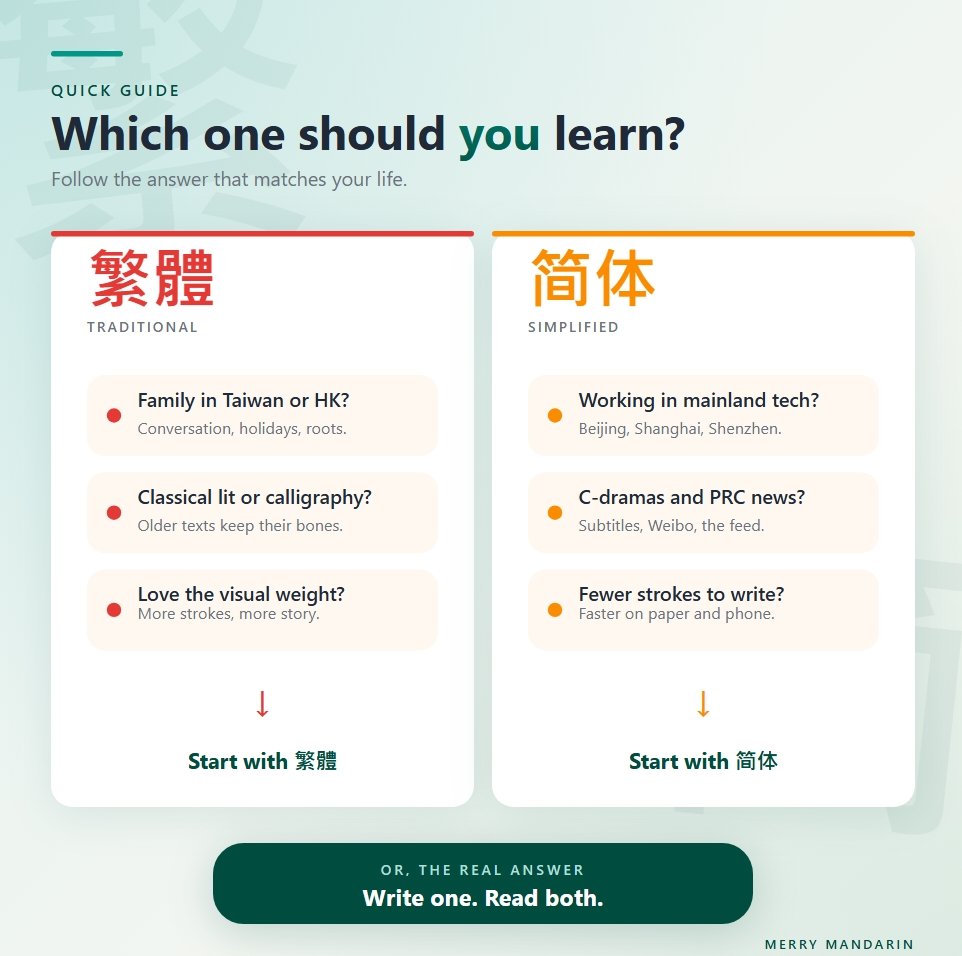
- Your partner's family in Kaohsiung. Traditional.
- A job posting in Shenzhen. Simplified.
- A grandmother in Hong Kong whose handwritten recipes you want to read. Traditional.
- Friends in Kuala Lumpur. Simplified.
- A heritage connection to a village your great-grandparents left before 1949. Almost certainly traditional, but check.
The question isn't which characters are better. It's whose kitchen you'll be sitting in.
The honest cost of switching mid-stream
Pivoting six months in isn't catastrophic. It's also not free.
You'll keep your vocabulary, your tones, your grammar, your ear. You'll rebuild a chunk of your writing muscle memory and re-train your eye on the ~35% of common characters that genuinely differ. Estimate a few weeks of friction, not a restart. The cost is real but bounded — and it's smaller than the cost of learning the wrong script for your actual life and never noticing until you're standing in a 台北 MRT station unable to read the exit signs fluently.
So pick deliberately the first time. The cost of guessing is the cost of pivoting.
The third path: read both, write one
Here's the move most apps won't tell you about, because their lesson trees can't support it.
Literate Chinese readers move between scripts constantly. Taiwanese viewers read mainland subtitles on streaming dramas without slowing down. Mainland readers pick up 紅樓夢 in a 繁體 edition and don't blink. The asymmetry is real — going from traditional to simplified is generally easier than the reverse, because simplifications are usually predictable component-level substitutions — but the bilingual-script habit is normal, not exotic. It's how educated Chinese speakers actually live.
For you, the practical version looks like this:
Write one system. The one tied to the place and people you chose above. Build deep muscle memory in that script.
Read the other passively. Once your active script is solid, recognition of the other comes faster than you'd guess — you already know the words, you're just learning a second visual form for ~35% of them.
This is not a compromise. It's how the language actually functions in the wild.
How to decide in the next ten minutes
Answer three questions, in order:
1. Who are the specific humans you want to read, write to, or talk with? Where do they live? What do they use?
2. Where do you plan to spend time in the next five years? Taiwan or Hong Kong? Mainland or Singapore? A diaspora community — and which one?
3. If neither answer narrows it, default to the script of the place you find more culturally magnetic. The one whose films, music, food, or literature already pull on you.
That's the whole framework. The aesthetics, the politics, the "which is more elegant" debates — they're someone else's argument. Your script is the one your life is asking you to read.
Start where you actually live.
Merry Mandarin treats 繁體 and 简体 as equals — same HSK 1–6 lessons, same 14,000-entry dictionary with classifiers and usage notes, same FSRS-5 review engine. Pick one to write. Toggle the other on when you're ready to read both. It's built for the way literate Chinese readers actually live. Try it free.